
How to Export Red Chilli Powder from India Legally
India stands as the world’s largest producer, consumer, and exporter of chillies, commanding nearly 40% of global production. Red chilli powder, a staple in kitchens worldwide, represents one of the most lucrative opportunities in agricultural exports. However, entering international markets requires strict adherence to legal frameworks, quality certifications, and compliance protocols that protect both exporters and importing nations.
Understanding the complete export process—from cultivation standards to final shipment—ensures your business operates within legal boundaries while maximizing profitability. This comprehensive guide walks you through every critical step required to export red chilli powder from India legally and efficiently.
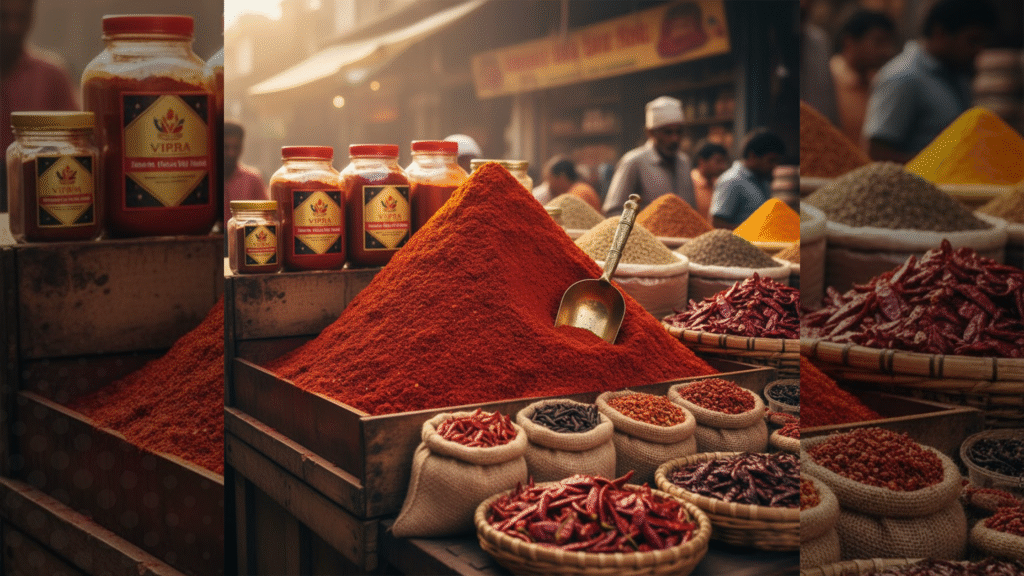
India’s Dominance in Global Spice Trade
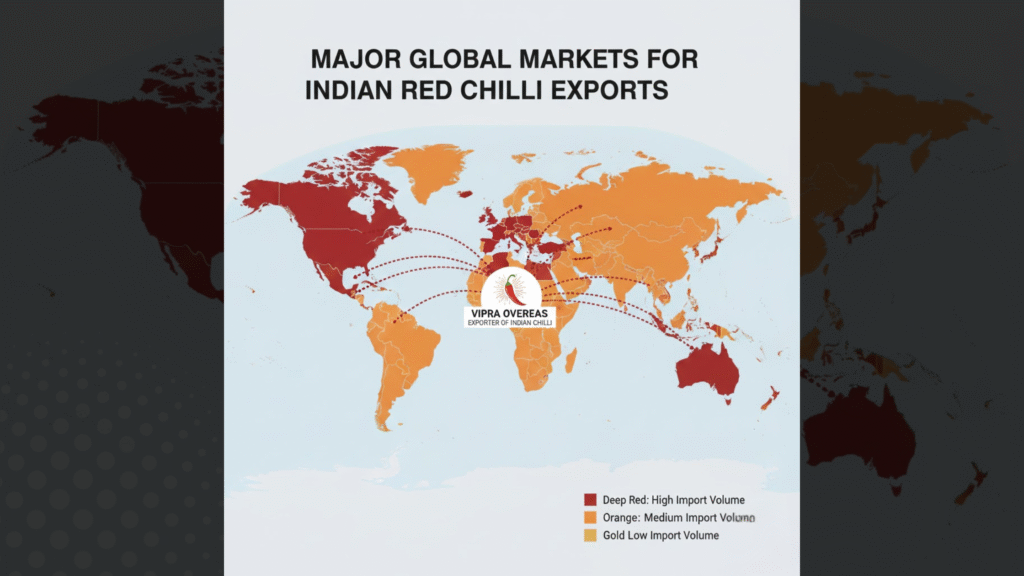
The country produces approximately 2 million metric tonnes of chillies annually across states like Andhra Pradesh, Telangana, Karnataka, and Madhya Pradesh. Indian red chilli powder enjoys global recognition for its pungency, color intensity, and medicinal properties. Major importing countries include the United States, United Kingdom, Middle Eastern nations, Southeast Asia, and European Union member states.
Export earnings from spices exceed $4 billion annually, with chilli powder accounting for a significant portion. The growing demand for authentic ethnic flavors and natural food colorants has created unprecedented opportunities for Indian exporters. However, maintaining this competitive edge requires understanding international quality expectations and regulatory compliance.
Quality Parameters for Export-Grade Red Chilli Powder
International buyers evaluate red chilli powder based on specific quality metrics. Moisture content must not exceed 10-12%, while color units typically range between 40-100 ASTA (American Spice Trade Association) depending on variety. Pungency levels, measured in Scoville Heat Units, vary from 30,000 to 50,000 for most export varieties.
Contamination control remains paramount. Products must be free from aflatoxins, pesticide residues, heavy metals, and foreign matter. Microbial load limits include total plate count, yeast and mold counts, and absence of harmful bacteria like Salmonella and E. coli. Testing laboratories accredited by NABL (National Accreditation Board for Testing and Calibration Laboratories) provide certification that meets international standards.

Essential Registrations and Licensing Requirements
Beginning the export journey requires obtaining specific registrations from government authorities. The first step involves securing an Importer Exporter Code (IEC) from the Directorate General of Foreign Trade (DGFT). This ten-digit code serves as your business passport for international transactions and remains mandatory for customs clearance.
Registration with the Agricultural and Processed Food Products Export Development Authority (APEDA) is crucial for spice exporters. APEDA provides market intelligence, quality control support, and promotional assistance. Their registration validates your facility’s compliance with food safety standards and export protocols.
An FSSAI (Food Safety and Standards Authority of India) license ensures your processing unit meets domestic food safety regulations. Choose the appropriate license category based on your annual turnover and production capacity. State FSSAI licenses work for smaller operations, while central licenses apply to larger facilities or those involved in interstate commerce.
Additional certifications enhance marketability. ISO 22000 demonstrates food safety management system compliance. Organic certifications from bodies like India Organic, USDA Organic, or EU Organic open premium market segments. Halal and Kosher certifications cater to specific religious dietary requirements in target markets.
Documentation Essentials for Legal Export
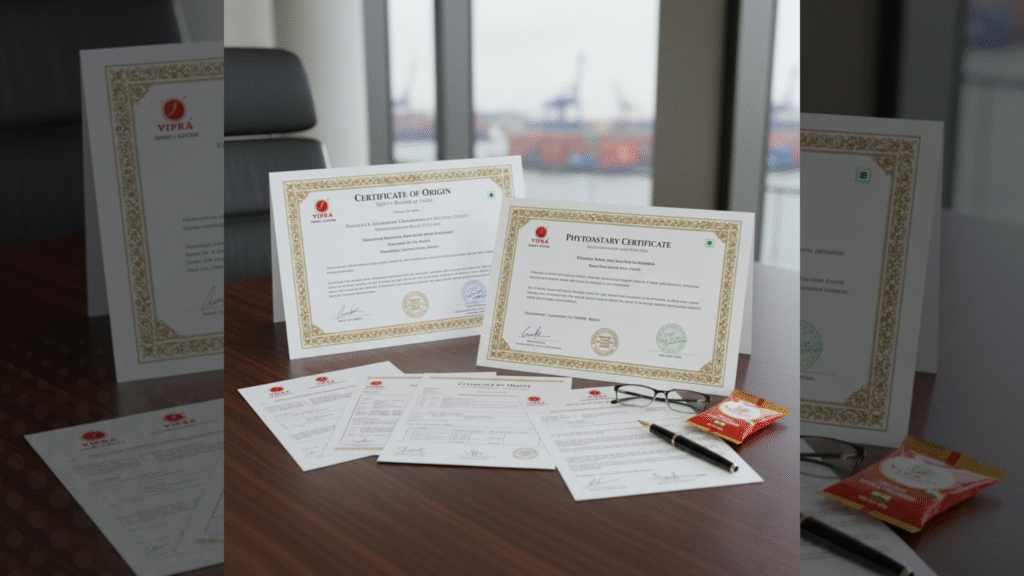
Export documentation forms the backbone of international trade compliance. Commercial invoices detail transaction specifics including product description, quantity, unit price, and total value. Packing lists enumerate contents of each package, facilitating customs inspection and cargo handling.
Phytosanitary certificates issued by Plant Quarantine authorities confirm your shipment is pest-free and meets plant health regulations of the importing country. Different nations have varying requirements, so verify specific phytosanitary conditions before shipment.
Certificate of Origin identifies India as the source country, potentially qualifying your products for preferential tariff treatment under trade agreements. Chambers of Commerce issue these documents after verification of manufacturing origin.
Health certificates or sanitary certificates may be mandatory for certain destinations, confirming the product meets health and hygiene standards. Laboratory test reports demonstrating compliance with maximum residue limits (MRLs) for pesticides and mycotoxins strengthen your documentation package.
Understanding Harmonized System Classification
Accurate HS code classification ensures correct duty assessment and smooth customs clearance. Red chilli powder falls under HS Code 0904.20 in most classifications. However, variations exist based on whether the product is whole, crushed, or ground. Verify the precise eight-digit or ten-digit code applicable to your specific product variant and destination country.
Misclassification leads to customs delays, penalties, and potential rejection of shipments. Consult with customs brokers or trade consultants familiar with both Indian export regulations and importing country requirements. Many destination countries publish detailed tariff schedules online for reference.
Packaging Standards and Labeling Compliance
Export packaging must protect product integrity throughout transportation while meeting importing country regulations. Food-grade materials prevent contamination and moisture ingress. Multi-layer packaging combining aluminum pouches, cartons, and corrugated boxes offers optimal protection for long-distance shipping.
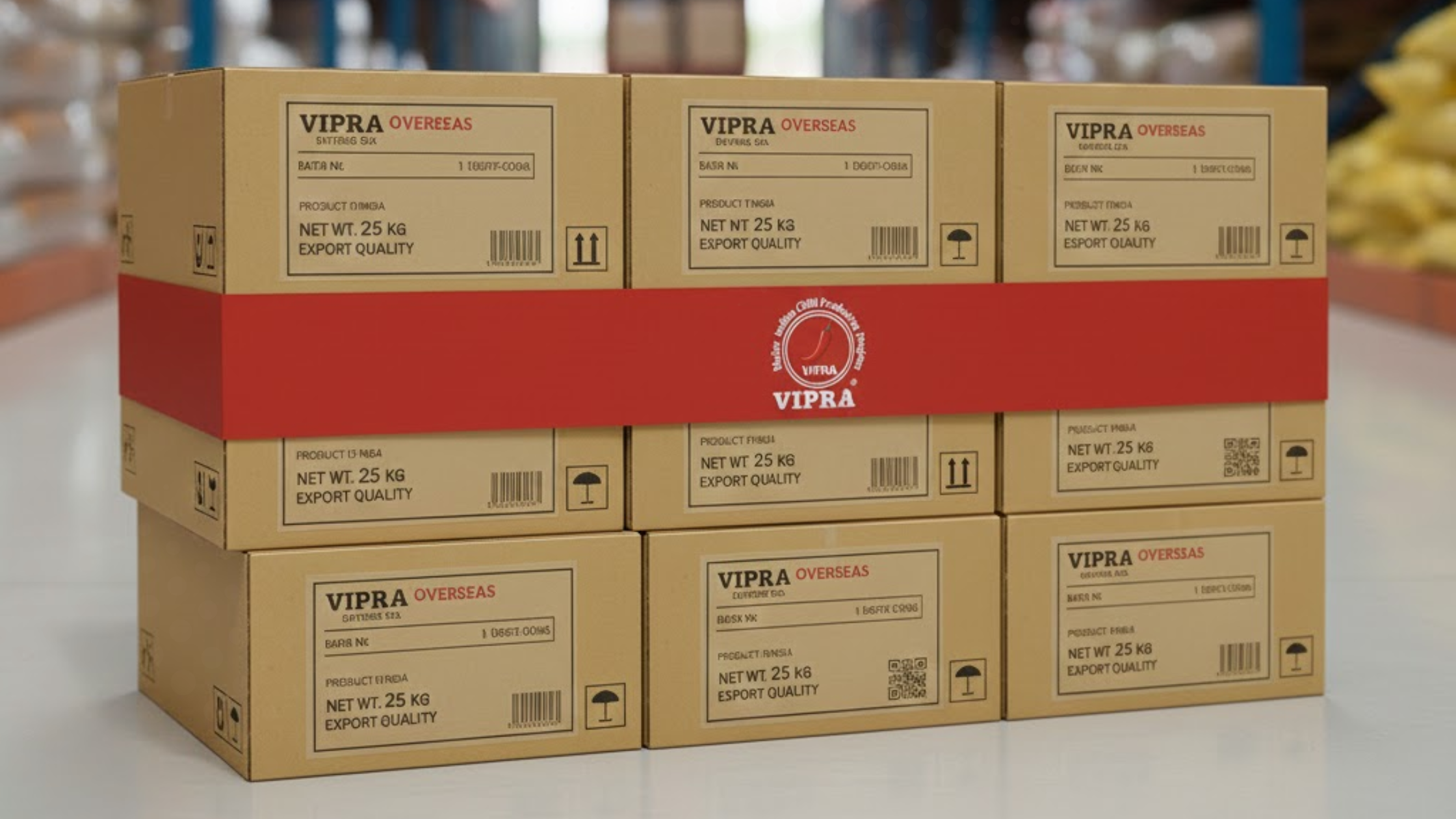
Package sizes should align with buyer requirements and market preferences. Consumer packs typically range from 50 grams to 1 kilogram, while bulk industrial packaging may use 10-25 kilogram bags or containers. Vacuum packaging extends shelf life and preserves volatile oils responsible for flavor and aroma.
Labeling requirements vary by destination but generally include product name, net weight, manufacturer details, country of origin, nutritional information, and allergen warnings. The United States requires FDA-compliant nutrition facts panels. European Union regulations mandate specific font sizes, multilingual labels, and traceability information.
Include batch numbers and manufacturing dates to enable traceability. Best-before dates or expiry dates help retailers manage inventory rotation. Barcode implementation facilitates retail distribution in modern supply chains.
Quality Control Throughout the Supply Chain
Implementing robust quality assurance protocols begins at procurement. Source raw chillies from certified growers who follow Good Agricultural Practices (GAP). Conduct initial quality checks for variety authentication, maturity level, and absence of visible defects.
Processing facilities must maintain hygiene standards comparable to international benchmarks. Regular cleaning schedules, pest control programs, and staff training minimize contamination risks. Temperature-controlled grinding prevents heat damage that degrades color and flavor compounds.
Third-party quality inspections before shipment provide independent verification. Many buyers specify pre-shipment inspection companies like SGS, Bureau Veritas, or Intertek. These agencies assess product quality, packaging integrity, and documentation accuracy, issuing inspection certificates that build buyer confidence.
Retention samples from each batch enable traceability if quality disputes arise post-shipment. Store samples under controlled conditions matching typical storage parameters, maintaining them until well past the product’s shelf life.
Logistics, Shipping, and International Transportation
Selecting appropriate shipping methods balances cost, speed, and product characteristics. Sea freight remains economical for bulk shipments, with transit times ranging from 15-45 days depending on destination. Containerized cargo in refrigerated containers (reefers) suits large volumes, though dry containers suffice for properly packaged chilli powder.
Air freight expedites delivery for premium products, urgent orders, or smaller quantities. Higher costs are justified when supplying time-sensitive markets or establishing relationships with new buyers who prefer trial shipments.
Work with experienced freight forwarders who understand perishable commodity handling and customs procedures. They coordinate pickup, documentation, customs clearance at origin, international transportation, and delivery to final destination. Comprehensive cargo insurance protects against loss, damage, or delays during transit.
Incoterms clarify responsibility division between buyer and seller. FOB (Free on Board) terms are common for Indian exports, where the seller arranges transport to the port and loads cargo onto the vessel. CIF (Cost, Insurance, and Freight) terms include insurance and ocean freight to the destination port. Understanding these terms prevents disputes about cost responsibility and risk transfer points.

Payment Methods and Financial Instruments
Secure payment mechanisms protect both parties in international transactions. Letters of Credit (LC) through established banks provide payment guarantees when all documentary conditions are met. Sight LCs release payment immediately upon document presentation, while usance LCs offer deferred payment terms.
Advance payment or telegraphic transfers suit established buyer-seller relationships with proven trust. However, new exporters should insist on secured payment methods until confidence develops. Export credit insurance from agencies like ECGC (Export Credit Guarantee Corporation) safeguards against buyer default or political risks.
The Rupee payment mechanism allows transaction settlement in Indian currency for specific countries, reducing foreign exchange risk. Stay updated on government notifications regarding permitted currency arrangements for different destinations.
Avoiding Common Export Pitfalls
Many first-time exporters face challenges that experienced traders navigate smoothly. Inadequate market research leads to targeting inappropriate markets or misjudging buyer expectations. Thorough research identifies genuine buyers, understands competitive pricing, and recognizes cultural preferences affecting product specifications.
Documentation errors cause significant delays and additional costs. Inconsistencies between commercial invoice, packing list, and certificate of origin raise red flags during customs inspection. Triple-check all documents for accuracy before submission.
Underestimating logistics timelines creates delivery failures. Factor in processing time for certifications, potential customs delays, and seasonal shipping congestion. Build buffer periods into delivery commitments, especially for initial shipments to new markets.
Neglecting after-sales communication damages relationships. Proactive updates about shipment status, prompt response to quality concerns, and willingness to address issues professionally build long-term partnerships. International trade thrives on trust and reliability beyond the initial transaction.
Value Addition Strategies for Competitive Advantage
Processing red chillies into various value-added forms expands market opportunities. Beyond basic powder, consider offering crushed chilli flakes, chilli paste, or specialized blends combining chilli with complementary spices. These products command premium pricing while catering to diverse culinary applications.
Organic certification opens niche markets willing to pay substantially higher prices. Though organic cultivation requires stringent protocols and transition periods, the market differential often justifies the investment. Similarly, geographical indication (GI) tagged varieties like Guntur Sannam or Byadgi chillies attract buyers seeking authentic regional characteristics.
Private labeling for international retailers provides steady business volumes. Supermarket chains and specialty food importers increasingly source directly from capable manufacturers who can meet their brand specifications consistently. Developing this capability requires investment in flexible packaging lines and quality systems but yields stable, recurring orders.
Market-Specific Compliance Considerations
The United States enforces strict food safety regulations through the FDA. The Food Safety Modernization Act (FSMA) mandates foreign supplier verification programs and preventive controls. Exporters must ensure their facilities meet Current Good Manufacturing Practices (CGMP) and may need to register with the FDA depending on product categories.
European Union regulations cover maximum residue limits, novel food requirements, and extensive labeling specifications. The EU’s General Food Law requires full traceability from farm to fork. Familiarize yourself with specific regulations of individual member states as requirements sometimes vary.
Middle Eastern countries often require Halal certification from recognized certifying bodies. Some nations also mandate specific port of entry procedures or pre-shipment inspection protocols. Gulf Cooperation Council (GCC) countries have harmonized many standards, but country-specific variations persist.
Leveraging Government Support Schemes
Indian government initiatives provide substantial support for agricultural exports. The Market Access Initiative (MAI) scheme offers financial assistance for export promotion activities including participation in international trade fairs, buyer-seller meets, and market surveys. APEDA administers several such programs specifically for spice exporters.
The Transport and Marketing Assistance (TMA) scheme subsidizes freight costs for eligible agricultural exports to specific markets. This assistance improves price competitiveness, particularly for distant markets where logistics costs significantly impact landed prices.
Export promotion councils and commodity boards conduct training programs, publish market intelligence reports, and facilitate buyer connections. Actively engaging with these organizations provides valuable insights and networking opportunities that individual exporters might struggle to access independently.
Building Long-Term Buyer Relationships
Sustainable export success stems from consistent quality delivery and transparent communication. International buyers value suppliers who proactively inform about potential challenges, whether crop failures affecting availability or regulatory changes impacting certifications. This transparency builds trust that withstands occasional difficulties.
Flexible business approaches accommodate buyer preferences regarding payment terms, packaging customization, and product specifications. While maintaining quality standards remains non-negotiable, demonstrating willingness to adapt to reasonable requirements strengthens partnerships.
Regular market visits to meet buyers personally and understand their operations create deeper relationships than email exchanges alone. Attending international food trade shows positions your company among serious players while providing face-to-face interaction opportunities with potential buyers and industry influencers.
How Vipra Overseas Facilitates Agricultural Exports
Navigating the complexity of international agricultural trade requires expertise, infrastructure, and established networks that take years to develop independently. Vipra Overseas specializes in exporting diverse agro products from India, offering comprehensive solutions that simplify the export process for farmers and processors.
Their product portfolio spans multiple categories meeting global demand. Fresh produce exports include seasonal fruits sourced from premium growing regions across India. The vegetable home category encompasses varieties suited for international retail chains and wholesale distributors. Whether tropical fruits products or temperate varieties, their sourcing network ensures consistent quality and timely availability.
Beyond fresh produce, Vipra Overseas handles beans in various forms—green beans, dried pulses, and specialty varieties meeting organic and conventional market requirements. Frozen product capabilities include individually quick frozen (IQF) vegetables and fruits, maintaining nutritional value and extending usability for institutional buyers.
Their spice export division manages comprehensive processing, testing, and certification for products like red chilli powder, turmeric, coriander, and spice blends. Understanding international quality benchmarks and regulatory requirements across different markets enables smooth clearance and buyer acceptance.
Grain exports complete their offering, connecting Indian agricultural abundance with global food security needs. Rice varieties, wheat, millets, and other cereals undergo stringent quality checks before export, ensuring products meet import specifications and food safety standards.
Vipra Overseas provides end-to-end support including quality assessment, documentation assistance, certification coordination, packaging solutions, and logistics management. Their established relationships with certifying agencies, testing laboratories, and freight forwarders accelerate processes that might otherwise create delays for individual exporters.
For farmers and processing units seeking to enter international markets without navigating regulatory complexities independently, partnering with experienced export houses like Vipra Overseas offers a viable pathway to global trade participation.

Staying Current with Regulatory Changes
International food regulations evolve continuously in response to emerging safety concerns, trade policy shifts, and scientific advances. Subscribing to trade publications, joining industry associations, and participating in exporter forums helps maintain awareness of relevant changes.
Government agencies including APEDA, Spices Board, and DGFT publish circulars and notifications regarding export policy modifications. Regular review of these official communications prevents non-compliance due to outdated knowledge. Many organizations also conduct webinars and training sessions addressing regulatory updates.
Maintaining dialogue with buyers about their market’s changing requirements provides frontline intelligence. Often, importers learn about regulatory changes before exporters, particularly regarding destination country rules. Collaborative information sharing strengthens mutual compliance and prevents shipment rejections.
Technology Integration for Export Excellence
Modern export businesses leverage technology for efficiency and transparency. Enterprise Resource Planning (ERP) systems integrate procurement, production, quality control, inventory management, and shipping documentation into unified platforms. This integration reduces errors, improves traceability, and accelerates response times.
Blockchain technology increasingly features in agricultural supply chains, offering immutable records of product journey from farm to consumer. While still emerging, blockchain adoption by major retailers and food companies suggests future competitive advantages for technology-enabled exporters.
Digital marketing through company websites, social media platforms, and B2B marketplaces expands buyer reach beyond traditional trade shows and personal networks. Professional online presence with detailed product information, certifications, and capability videos attracts quality inquiries from serious international buyers.
Practical Steps to Begin Your Export Journey
Start by conducting thorough market research to identify target countries with strong demand for red chilli powder. Analyze competition, pricing structures, and specific quality preferences of potential buyers. This groundwork informs production planning and quality specifications.
Simultaneously, initiate the registration process for IEC, APEDA, and FSSAI licenses. These approvals require several weeks, so early application prevents delays when export opportunities arise. Invest in necessary infrastructure for quality processing, testing facilities, and proper storage conditions.
Connect with trade promotion organizations, export councils, and industry associations. Their guidance, training programs, and buyer databases provide valuable resources for newcomers. Consider engaging experienced export consultants for initial shipments to navigate documentation and compliance successfully.
Prepare sample products meeting export quality standards and approach potential buyers with professional product presentations. Be prepared for rigorous quality evaluation and potentially extended negotiations before securing first orders. Initial transactions may involve smaller quantities as buyers assess your reliability and product consistency.

Conclusion
Exporting red chilli powder from India legally demands comprehensive understanding of quality standards, regulatory requirements, and international trade practices. Success requires meticulous attention to documentation, unwavering commitment to quality, and strategic relationship building with buyers worldwide.
The opportunities are substantial—global appetite for authentic Indian spices continues growing as culinary diversity expands worldwide. With proper preparation, appropriate certifications, and consistent execution, exporters can tap into lucrative international markets while contributing to India’s agricultural export growth.
Starting with thorough market research, obtaining necessary registrations, implementing robust quality systems, and partnering with experienced logistics providers creates a foundation for sustainable export business. Whether operating independently or collaborating with established export houses, maintaining legal compliance and quality excellence remains paramount.
The journey from local spice producer to international exporter transforms businesses while showcasing India’s agricultural heritage globally. With dedication, proper planning, and adherence to regulatory frameworks, exporting red chilli powder legally becomes not just possible but profitable for those committed to excellence in global trade.